
Ship Steering Technique
Ship-Steering Technique
This is a technique for steering submarines, torpedos and other craft without the external rudders that cause cavitation.
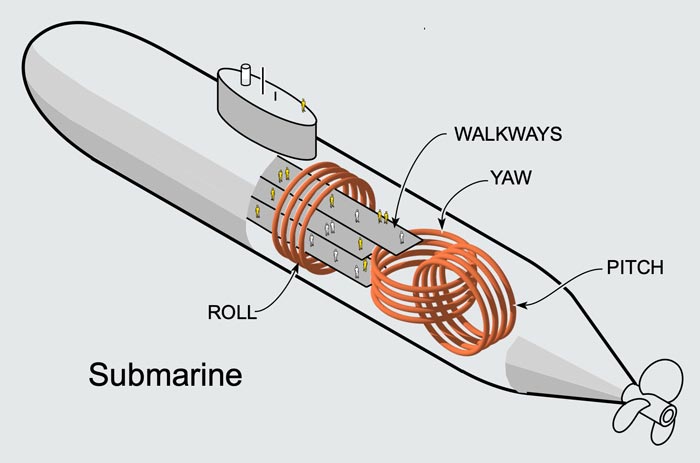
Steering (changing the pitch, tilt or yaw direction) of submarines, space craft, satellites, and missiles has involved rotation of flywheels. causing the craft to turn in the opposite direction. In the case of steering an underwater submarine, large spinning flywheels would obviously be an obstacle and hazard to the crew.
This describes a technique kept completely internal to the craft, reducing drag (cavitation in the case of ships, submarines and torpedos).


Propellers circulate water through mutually-perpendicular propulsion tubes to create back pressure to move the ship to pitch, roll and yaw (a trick reverse engineered from the human inner ear).
Propellers circulate water through mutually-perpendicular coils to create back pressure to move the theater to pitch, roll and yaw.
Coils (for each of pitch, roll and yaw) made of modular propulsion tubes with propellers. The back pressure to the hull is proportional to the number of circular pipes (the more the better to increase back pressure).
Military Application:
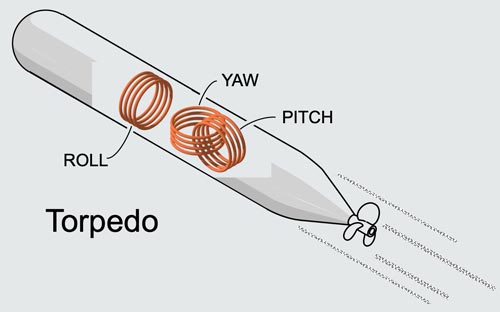
The watercraft can be simplified using mutually-perpendicular water pipes. The absence of rudder and hydrofoils eliminates two of the three sources of cavitation.
The traditional way of exerting rotary motion (pitch, roll, or yaw) was to use spinning flywheels as used in GPS satellites. This technique could not be scaled up for submarines because of the hazard to crew members of having an exposed flywheel.
Using water-filed coils has the enormous advantage over flywheels of being hollow at the core, allowing passage ways in the sub to walk through.
2-3 floors unobstructed
 |
|
notebook #2 p. 080 |
This patent-pending steering technique is available for license from HinesLab. Please contact Steve Hines at:
HinesLab