
Counterbalanced Image Stabilizer
Kodak Counter-Balanced Image Stabilizer

This camera-shake compensating mechanism works passively and requires no electrical power, gyros or warm-up time. Developed by Steve Hines in 1977 at the Kodak Research Laboratories.
 |
The image stabilizer in a clear camera body, showing the lens, film and holder, and three parallel support legs. The lens and film counter balance each other on opposite ends of the three legs which are the same length as the focal length of the camera lens, so as to not over or under correct image smear. |
|
The shake-compensating mechanism is inside the camera housing. If your hand shakes, the camera body moves, but inertia causes the mechanism to lag behind. The lens remains on a line between the object and its image on the film. |
|
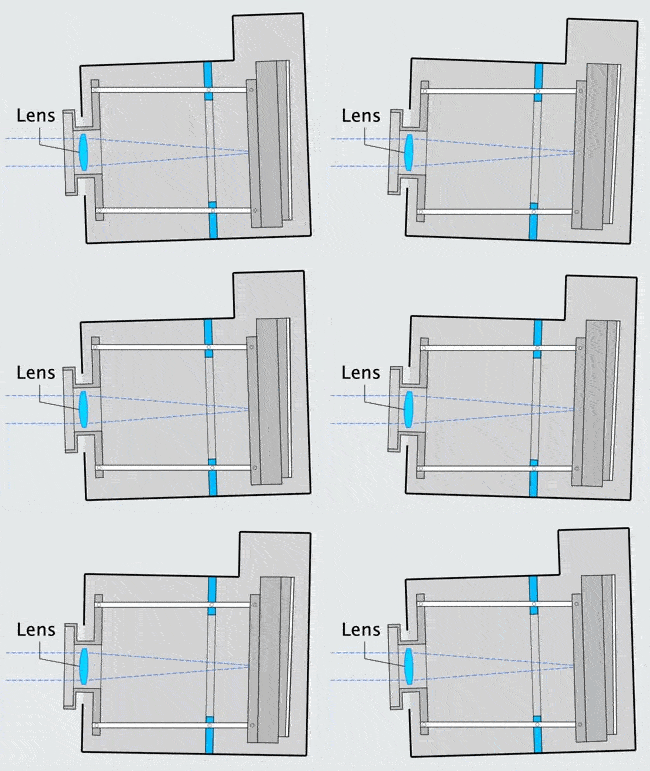
Defocusing, measured 57mm off axis in the corners, based on a 100mm focal-length camera lens.
| Pitch or yaw |
conventional stabilizer- mm (smaller is better) |
Kodak – Hines stabilizer- mm (smaller is better) |
| 0° | 0.0 | 0.0 |
| 1° | 1.15 | 0.02 |
| 2° | 2.3 | 0.06 |
| 3° | 3.46 | 0.14 |
| 4° | 4.62 | 0.22 |
| 5° | 5.9 | 0.38 |
What it provides:
Pitch and yaw camera motions have the most serious effect on image smear. Tipping a camera down 1°, has the effect of lifting an object at 50 feet, 10 inches. This shake-mechanism compensates for five times that amount of image smear..
The mechanism is not affected by being bumped.
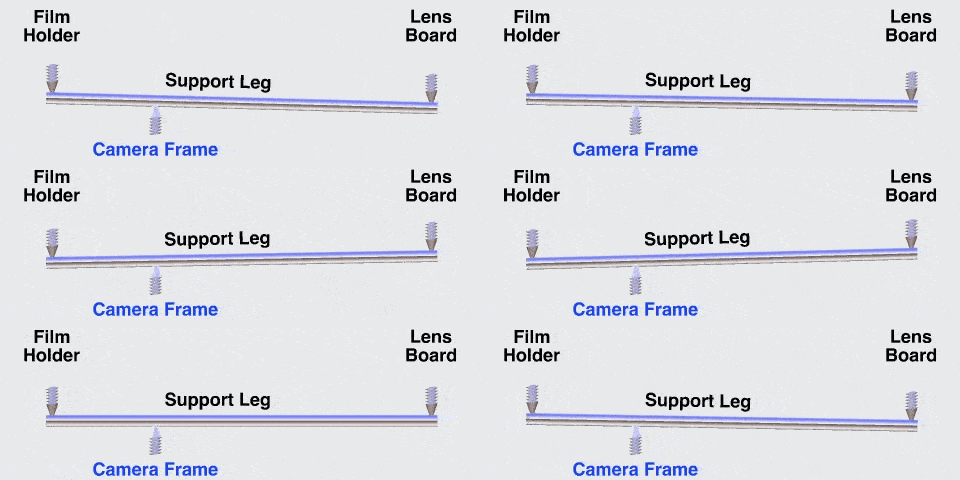
The mechanism connects the three legs to the film holder and lens board with agile cone-and-cup supports (a 2-axis version of a knife-edge hinge).
Pressing the shutter button unleashes the mechanism during the film exposure.
The concept applied to a 110-format camera:
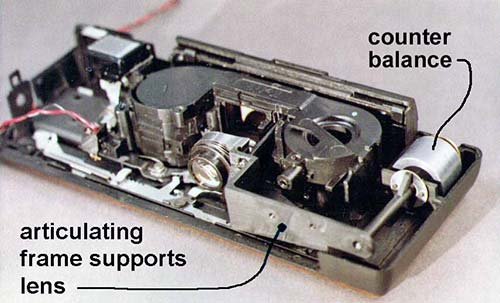
In the case of a more traditional camera, with film in a light-weight cartridge, the weight of the lens is counterbalanced by an offset weight.
Hines’ lab notebook p. 72