
Film Pulldown Claw
Film Pull-Down Claw
for movie cameras and projectors
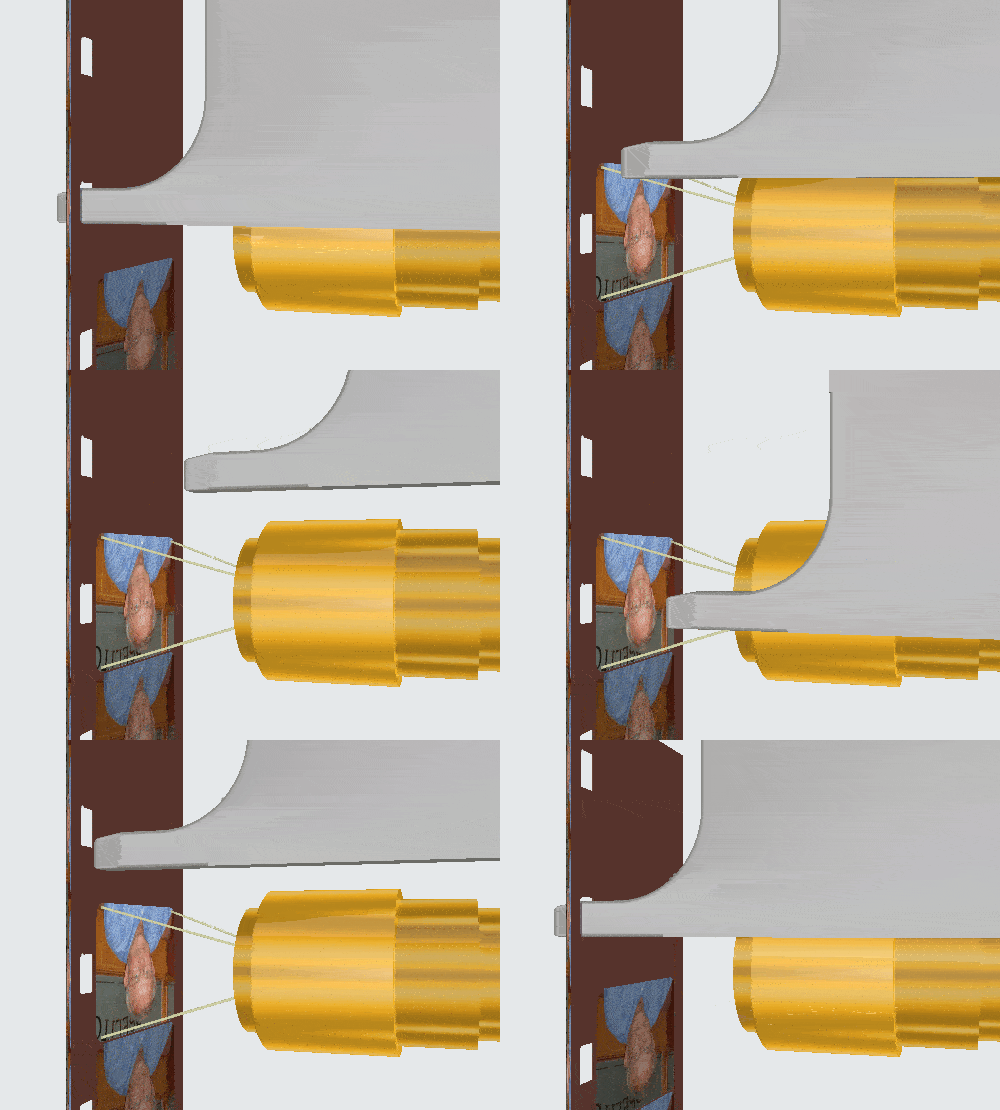
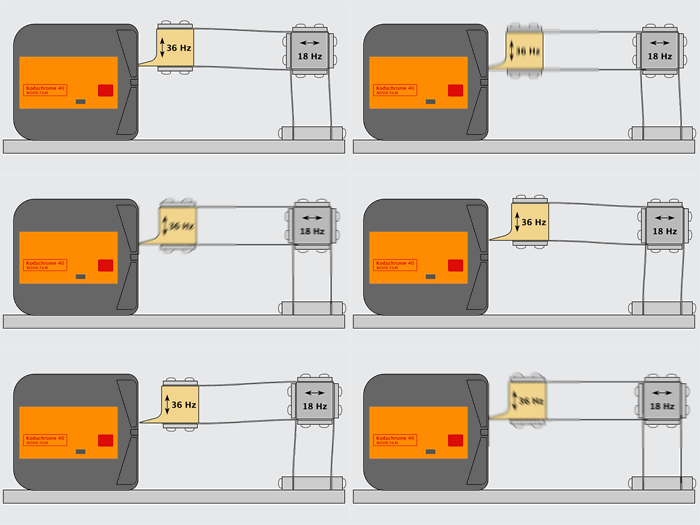
This is a concept for a quiet film pull down, eliminating the cost and weight of the traditional motor. The claw bounces vertically at the frame rate (18 Hz for Super 8) to create a gentle start and stop, while providing the maximum speed during the film advance.
The claw vibrates horizontally at a multiple of the frame rate chosen to alter the duty cycle and exposure time. This quiet pull-down technique is well suited for available-light sound movie cameras. Developed by Steve Hines in 1977 at the Kodak Research Laboratories.
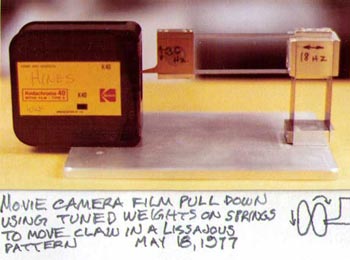 Lab notebook entry. Lab notebook entry. |
|
 |
|
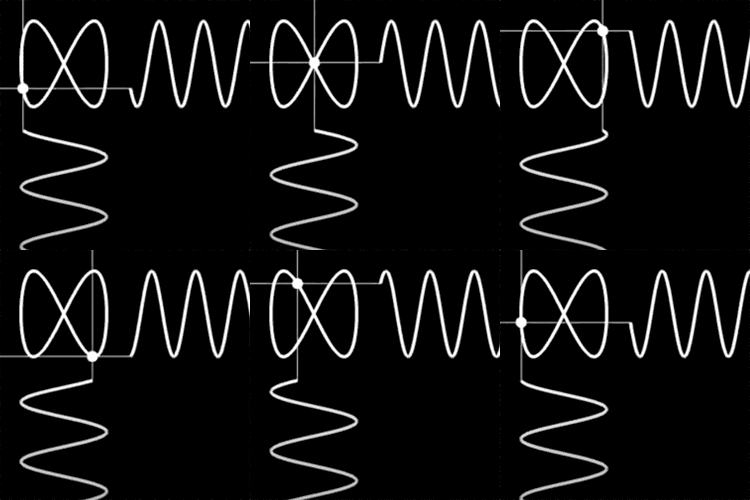
The film pull-down claw moves in a Lissajous pattern, created by the phase relationship of vibrating vertical and horizontal spring-steel parallelogram supports.
|
Duty Cycle
The quicker the film pulldown, the more time there is available for exposure.
In the 2:1-ratio version the pulldown occupies approximately 25% of the total path, requiring a 90° rotating dark shutter, therefore allowing for a 270° open shutter, for longer exposure than the typical 180° shutter-angle camera.
 |
 |
 |
| 2:1 ratio | 3:1 ratio | 4:1 ratio |
|
36Hz vertical 18Hz horiz. |
54Hz vertical 18Hz horiz. |
72Hz vertical 18Hz horiz. |
| ≈270° open shutter | ≈300° open shutter | ≈315° open shutter |
All patterns are based on the 18 Hz frame rate of Super 8 cameras.
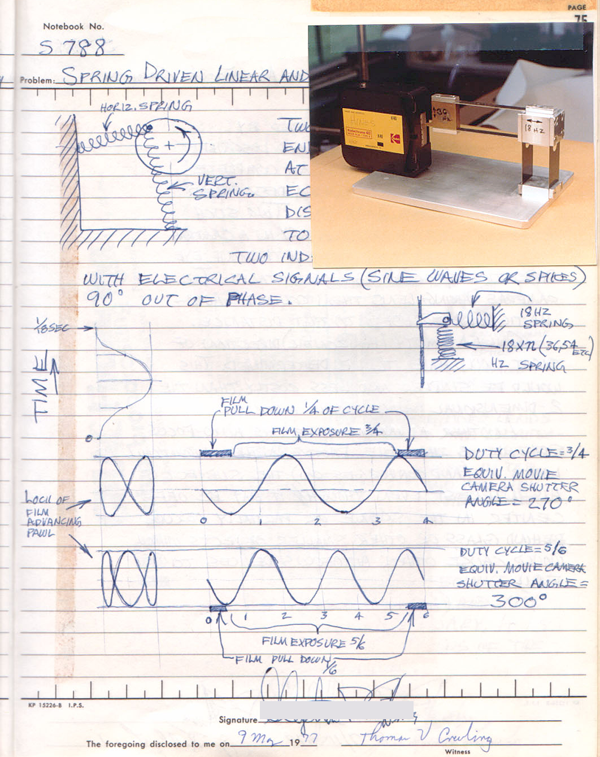
Hines’ Kodak Lab Notebook entry, p. 75, March 9, 1977
Further development includes adding electromagnetic coils to keep the mechanism in motion.
For questions, please contact Steve Hines at: